Isn't this just part of the job?
It is part of the job, and it is also a recognised hazard.
A solicitor in a sexual offences or homicide practice may review distressing evidence most days. They prepare victims and witnesses for court and hear the same events described many times over.
Exposure builds up across matters and over time, and several hard matters can land on the same solicitor at once. This is hard to track from the outside, even for a manager who knows the team well.
What counts is how many hard matters a solicitor is carrying at once, and for how long.
Isn't the support we already offer enough?
Current support helps people after they are affected.
Most offices offer counselling and wellbeing programs. These help people once they are affected. They do not show where exposure is building, and they do not change who receives the next difficult matter.
TrueWeight works earlier, when the work is being allocated. It provides you with an indicator for a manager to start the conversation.
Work Health and Safety Regulations 2011 (Cth), regulation 55D Control measures
(1)This regulation applies to a person conducting a business or undertaking who implements control measures to manage psychosocial risks in accordance with Part 3.1.
(2)In determining the control measures to implement, the person must have regard to all relevant matters, including:
(a)the duration, frequency and severity of the exposure of workers and other persons to the psychosocial hazards; and
(b)how the psychosocial hazards may interact or combine; and …
- Duration
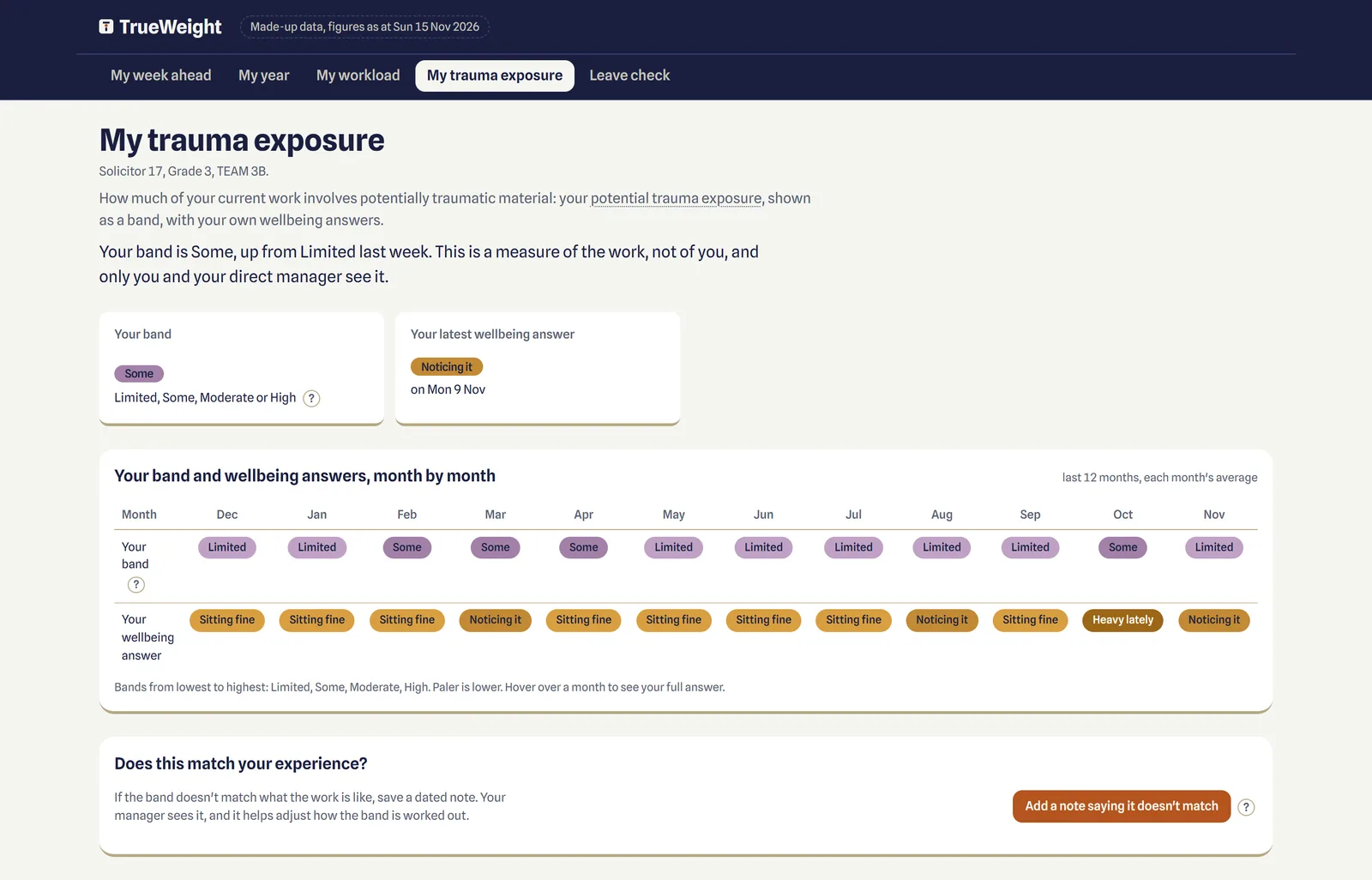
How long a person is exposed. TrueWeight follows each matter through its stages, so exposure rises when the work is intense and falls when it is not.
- Frequency
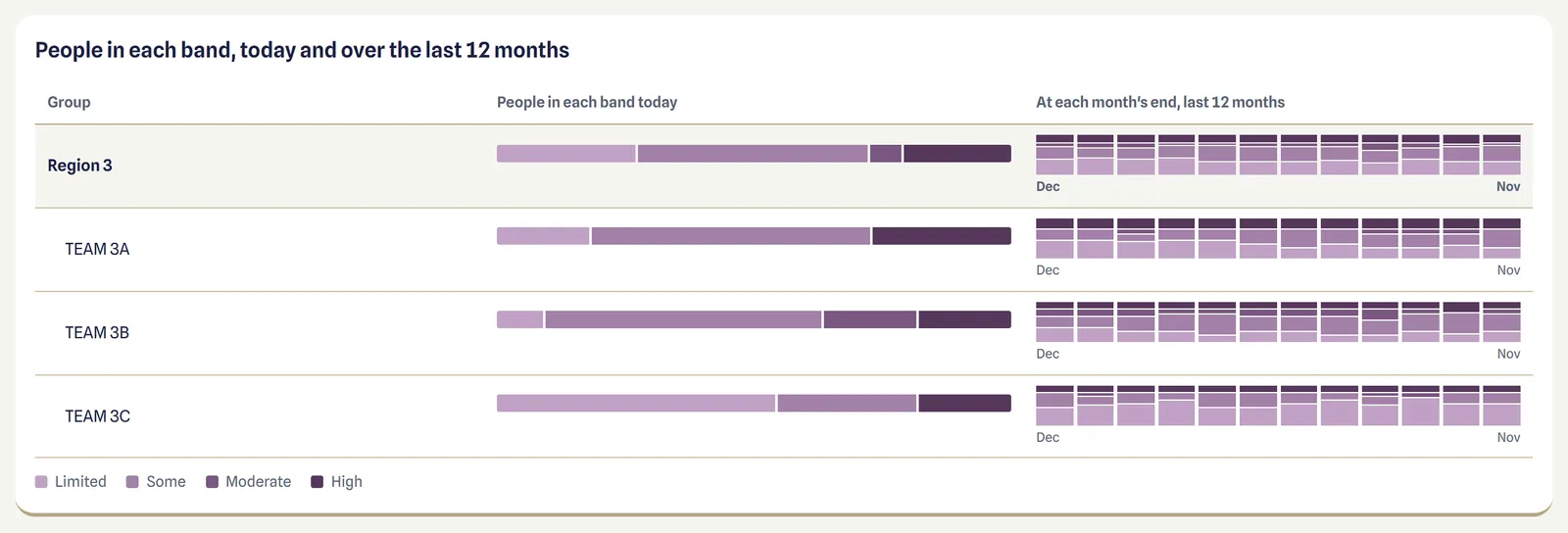
How often, and how much at once. TrueWeight adds up what a person is carrying today, across every matter they hold.
- Severity
How hard the material is. Every matter is rated for trauma exposure when it is assessed, from its content and the people involved.
How it works together.
Paragraph (a) looks at each part of a person's exposure on its own. Paragraph (b) looks at what happens when several hazards land on the same person at the same time.
TrueWeight brings the two together. Because every rated matter a person holds is added up day by day, it also shows when several hard matters are coming to a head at once.
The result is one current picture of each person's exposure risk. A manager can use it when deciding who takes the next matter, so the way work is allocated takes exposure into account.
Adopted across Australia.
The psychosocial regulations began as model laws. Each jurisdiction has now made them its own. New South Wales moved first and has gone furthest.
New South Wales
Work Health and Safety Regulation 2025, clauses 55A to 55D
In force since 1 October 2022. Regulation remade 22 August 2025.
The hierarchy of controls applies to psychosocial risk, so work design and allocation sit above training and counselling. The Code of Practice became legally binding on 1 July 2026 (WHS Act section 26A).
Commonwealth
Work Health and Safety Regulations 2011, regulations 55A to 55D
In force since 1 April 2023.
The Commonwealth Code of Practice 2024 lists exposure to traumatic events or material and asks for reporting systems for exposure and monitoring of worker health after it.
Victoria
Occupational Health and Safety (Psychological Health) Regulations 2025, regulations 14 to 16, with OHS Act section 22
In force since 1 December 2025.
Victoria's own wording. The Compliance Code names lawyers, says exposure to traumatic content can be cumulative, and lists monitoring employees with repeated exposure and preventative wellbeing checks for high-risk roles as controls.
Also Queensland (April 2023), ACT (November 2023), Western Australia (December 2022), Tasmania (December 2022), Northern Territory (July 2023) and South Australia (December 2023). South Australia's Code of Practice of February 2026 expressly includes vicarious and cumulative trauma exposure.
The duty is practical.
An employer is expected to work through these steps, in consultation with its people. Regulation 55C says psychosocial risks are managed through the ordinary risk management process. These are its steps.
What the law expectsHow TrueWeight helps
- 1Identify the hazardEvery matter is rated for trauma exposure when it is assessed.
- 2Assess the risk, by duration, frequency and severityEach person's exposure risk is kept current and shown as a band.
- 3Control it through the way work is designedAllocation can take exposure into account, so the work is spread more evenly.
- 4Review how the controls are workingFlags prompt a review, and what was done is recorded. Managers and executives can see patterns over time.
Training and counselling remain important. Regulators are clear that they are not sufficient where the design of the work itself can be changed. In New South Wales that is now written into the regulation.
TrueWeight supports each of these steps. It helps an office's efforts in being compliant. The duty stays with the employer.
What the codes say about traumatic material.
“Flag files containing traumatic content” and “limit exposure time”.
Victorian Compliance Code“Monitor employees with repeated exposure” and “regular preventative wellbeing checks for high-risk roles”.
Victorian Compliance Code“Reporting systems for exposure to traumatic or distressing events” that prompt supervisor support.
Commonwealth Code of Practice 2024
General information only, not legal advice. Duties vary between jurisdictions. Regulation wording as at the date of publication.
What if our laws are different?
The hazard is the same in every jurisdiction.
Laws differ between countries, but prosecution work is much the same everywhere. Any office can ask who is carrying its hardest matters and how many they hold at once.